
Temperature controlled shipping is the process of moving goods within strictly maintained temperature ranges to protect their integrity from collection to delivery. In the UK, this spans three core bands: controlled room temperature (15°C–25°C), refrigerated (2°C–8°C), and frozen (0°C and below), each requiring different vehicles, packaging, and monitoring protocols. Pharmaceuticals, fresh food, biologics, and certain chemicals all depend on this discipline. A single temperature excursion can render a batch of vaccines ineffective or trigger a costly product recall.
The benefits are concrete: reduced spoilage, regulatory compliance, and verifiable chain of custody from origin to recipient. UK operators must align with Good Distribution Practice (GDP) standards and, where applicable, ADR regulations for hazardous goods. Real-time IoT monitoring and telematics have made it possible to detect and correct deviations mid-transit rather than discovering failures at the point of delivery.
- Controlled room temperature: 15°C–25°C, suitable for stable pharmaceuticals and certain food products
- Refrigerated: 2°C–8°C, required for vaccines, biologics, fresh produce, and dairy
- Frozen: 0°C and below, used for frozen food, certain biologics, and dry ice shipments
- Ultra-cold: down to -70°C, needed for specific vaccines and cryogenic materials
- Key sectors: food and beverage, pharmaceuticals, biotech, chemicals, and fresh floriculture
What types of temperature controlled shipping are available in the UK?
The UK market offers a broad range of cold chain logistics solutions, from single-pallet chilled road freight to multi-modal pharmaceutical air shipments.
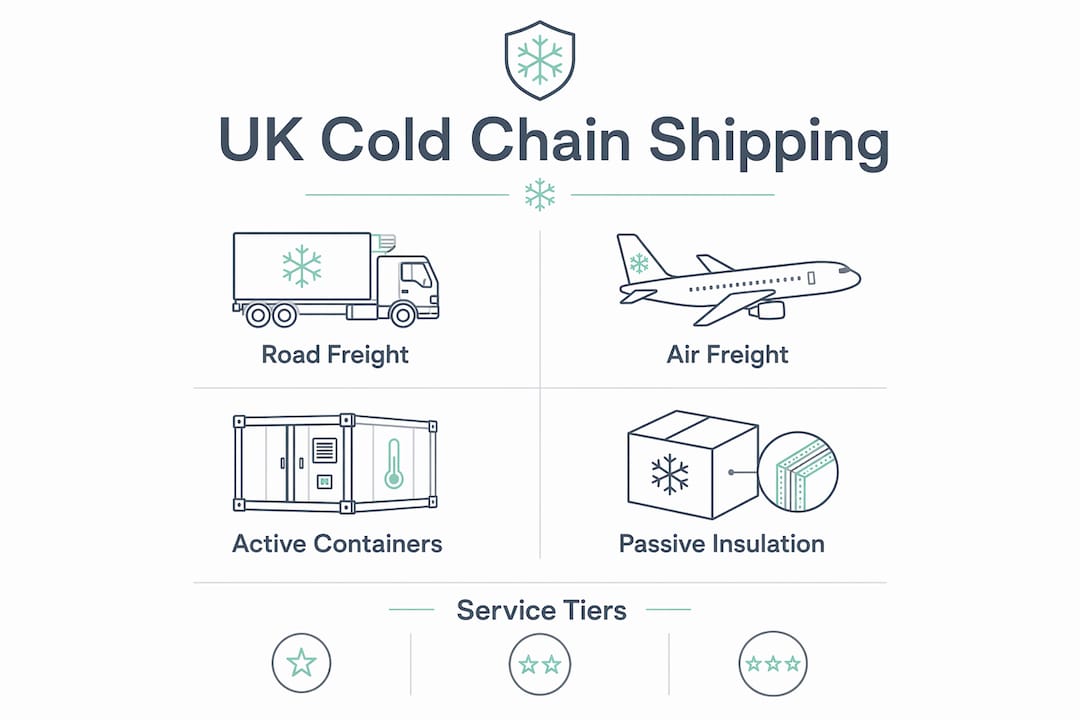
Road freight remains the dominant mode. Specialised refrigerated trucks carry chilled or frozen cargo on dedicated routes, with multi-temperature trailers capable of running separate compartments at different set points simultaneously. For urgent consignments, same day refrigerated couriers operate across the country.
Air freight suits time-critical or high-value shipments. Active containers with power-based cooling and passive insulated shippers validated for 24–48+ hours both feature in air cold chain operations. Passive systems are often faster to deploy for urgent dispatch; active units offer tighter control on longer routes.

Sea freight uses reefer containers, which maintain precise temperatures for bulk perishable or frozen cargo on international lanes. UK exporters shipping chilled seafood or frozen goods to Europe and beyond rely heavily on this mode.
Packaging options vary by transit duration and product sensitivity:
- Active refrigeration units: powered cooling for long-haul or highly sensitive cargo
- Passive thermal shippers: insulated boxes with gel packs or dry ice, cost-effective for short to mid-range transit
- Dry ice: essential for ultra-cold shipments, requires ventilated packaging and compliance with IATA regulations
- Gel packs: pre-conditioned and suited to the 2°C–8°C refrigerated range
Service tiers include same day, next day, 24-hour, 48-hour, and fully customised schedules. Additional capabilities such as hazardous goods handling under ADR, bonded storage, and cross-border customs management extend the scope well beyond basic refrigerated delivery.
What regulations and technologies govern cold chain reliability in the UK?
UK cold chain operations sit within a clear regulatory framework. GDP (Good Distribution Practice) sets the standard for pharmaceutical distribution, covering temperature monitoring, documentation, and handling procedures throughout the supply chain. ADR certification is mandatory for transporting dangerous goods by road, including certain chemicals and dry ice consignments. Membership of the Cold Chain Federation signals adherence to industry best practice, while EU GDP compliance remains relevant for cross-border pharmaceutical shipments post-Brexit.
IoT sensors and telematics now provide real-time tracking of temperature, humidity, and location, enabling dispatchers to remotely adjust refrigeration set points and respond to excursions before product integrity is compromised. Continuous data logging creates an unbroken digital audit trail, which is the foundation of GDP compliance and HACCP validation. Door sensors alert operators whenever cargo doors open, preventing unnecessary temperature spikes during loading and unloading.

Monitoring alone is not sufficient. Experienced logistics teams build buffer cooling capacity into packaging and plan contingency re-icing at transit hubs so that delays do not automatically become excursions. Documentation requirements include temperature validation reports, shipper's declarations for dangerous goods, and labelling with handling instructions. Together, these elements form a traceable, auditable record that satisfies both UK regulators and international customs authorities.
Comparing leading UK temperature controlled shipping providers
The UK market includes specialists ranging from nationwide food logistics networks to niche healthcare couriers. Each provider below serves a distinct segment.
| Provider | Core services | Coverage and modes | Delivery speed | Tracking | Certifications | Best for | Rating |
|---|---|---|---|---|---|---|---|
| Peter Green Chilled | Chilled, frozen, ambient food logistics; storage; customs | UK and Europe; road | Next day | EDI order processing | Market-leading food logistics | Nationwide food businesses | 4.2★ (266) |
| JJX Logistics | Time-critical courier; chilled; ADR; bonded storage | Road, rail, sea, air | Same day, 24h, 48h | 24/7 real-time vehicle tracking | ADR certified; Hazchem Network | Urgent and hazardous shipments | 4.5★ (149) |
| Jag Express | Healthcare courier; dry ice; hazardous goods; international | UK and international; road, air | Same day, next day | Not publicly listed | 20+ years healthcare experience | Pharmaceutical and biotech | 5★ (29) |
| Rhodes Freight Services Ltd | Dedicated temperature controlled vehicles; air freight; warehousing | UK, Europe, global; road, air | 24/7 service | Not publicly listed | 30+ years experience | Perishable goods exporters | 4.6★ (25) |
| PMA Transport - Nationwide Same Day Couriers | Same day temperature controlled courier | UK nationwide; road | Same day | Not publicly listed | Same day specialist | Fast domestic shipments | 4.8★ (24) |
| FET Logistics Ltd - Healthcare & Temperature Controlled Logistics UK | Healthcare temperature controlled logistics | UK; road | Not publicly listed | Not publicly listed | Healthcare specialist | Medical freight clients | 5★ (5) |
| Speedy Freight South East London | Same day and next day courier; ADR; customs clearance; air freight | London, UK, Europe, worldwide; multi-modal | Same day, next day | Not publicly listed | ADR licensed | London-based businesses | 3.3★ (7) |
| Cool Cargo UK | Air, road, and sea cold chain; pharma courier | UK, Europe, global; air, road, sea | Not publicly listed | Not publicly listed | FTA Member; Cold Chain Federation; EU GDP | Food and pharma cold chain | 3.7★ (6) |
| INTERSCAN LIMITED | Temperature controlled logistics | UK; road | Not publicly listed | Not publicly listed | Not publicly listed | General temperature sensitive cargo | — |
Peter Green Chilled is the largest food-focused operator on this list, running a nationwide next day network for chilled, frozen, and ambient products with integrated storage, blast freezing, and UK customs services. Businesses shipping food at volume across the UK and into Europe will find few providers with comparable infrastructure.
JJX Logistics stands out for combining 24/7 real-time vehicle tracking with ADR certification and bonded hazardous goods warehousing. That combination suits clients whose cargo is both time-critical and regulated, such as chemical samples or excise goods requiring secure cold storage.
Jag Express has built its reputation specifically in healthcare and pharmaceutical logistics over more than 20 years. Dry ice courier services and hazardous goods expertise make it the natural choice for biotech labs and hospital supply chains that cannot afford ambiguity in transit conditions.
Rhodes Freight Services Ltd brings over 30 years of experience in perishable goods transport, with dedicated temperature controlled vehicles and global reach via air freight. Flower importers, fresh produce exporters, and pharmaceutical distributors with European or international lanes use this provider for its depth of coverage.
Cool Cargo UK holds Cold Chain Federation membership and EU GDP certification alongside FTA membership, covering air, road, and sea freight. For food and pharmaceutical clients who need multi-modal cold chain with documented regulatory compliance, those credentials carry real weight.
Speedy Freight South East London offers ADR transport combined with customs clearance and multi-modal freight, making it practical for London-based businesses needing a single provider for both temperature sensitive and regulated cargo.
PMA Transport focuses on same day domestic delivery for temperature sensitive cargo. FET Logistics Ltd targets the healthcare sector specifically. INTERSCAN LIMITED offers temperature controlled logistics; detailed service information is not publicly listed.
Statistic to note: Temperature controlled shipping costs more than standard freight due to specialised vehicles, energy consumption, and monitoring technology. Factoring these costs into procurement decisions from the outset avoids budget surprises.
How do you choose the right temperature controlled shipping provider in the UK?
Start with the cargo profile. The temperature range your product requires, its sensitivity to excursions, and its regulatory classification will immediately narrow the field. A pharmaceutical biologic requiring 2°C–8°C with GDP documentation is a different brief from a pallet of frozen ready meals.
Key evaluation criteria:
- Certifications: ADR for hazardous or dry ice shipments; Cold Chain Federation membership; GDP compliance for pharmaceuticals
- Tracking capability: 24/7 real-time monitoring with live alerts, not just end-of-journey reports
- Geographic coverage: confirm the provider covers your specific origin and destination, including cross-border if relevant
- Contingency planning: ask whether they build buffer coolant capacity into packaging and have re-icing points on extended routes
- Transit time options: same day, next day, or scheduled; match the service tier to your product's stability window
- Special cargo handling: hazardous goods, bonded storage, customs clearance if needed
- Insurance and liability: confirm coverage for temperature excursion losses, not just physical damage
Questions worth asking any provider directly: What is your documented excursion response protocol? Can you provide temperature validation reports on delivery? How do you handle customs delays for cross-border shipments?
Expert logistics partners conduct bespoke risk assessments that weigh routes, potential delays, and seasonal conditions to select the right packaging and transport method for each shipment. A provider who offers this level of pre-shipment analysis is worth more than one who simply quotes a vehicle type.
Pro Tip: Ask whether your provider uses ISTA-validated thermal shippers. Pre-qualified packaging validated for 36–48+ hours across frozen, 2°C–8°C, and controlled room temperature profiles significantly reduces excursion risk compared to ad-hoc solutions, particularly for high-value research or pharmaceutical cargo.
Pegasus-peptides: temperature controlled shipping for research peptides
The providers compared above serve food logistics, general freight, and broad pharmaceutical distribution. Pegasus-peptides addresses a more specific requirement: researchers who need research-grade peptides shipped with the same cold chain discipline, but at the individual order level rather than pallet scale.
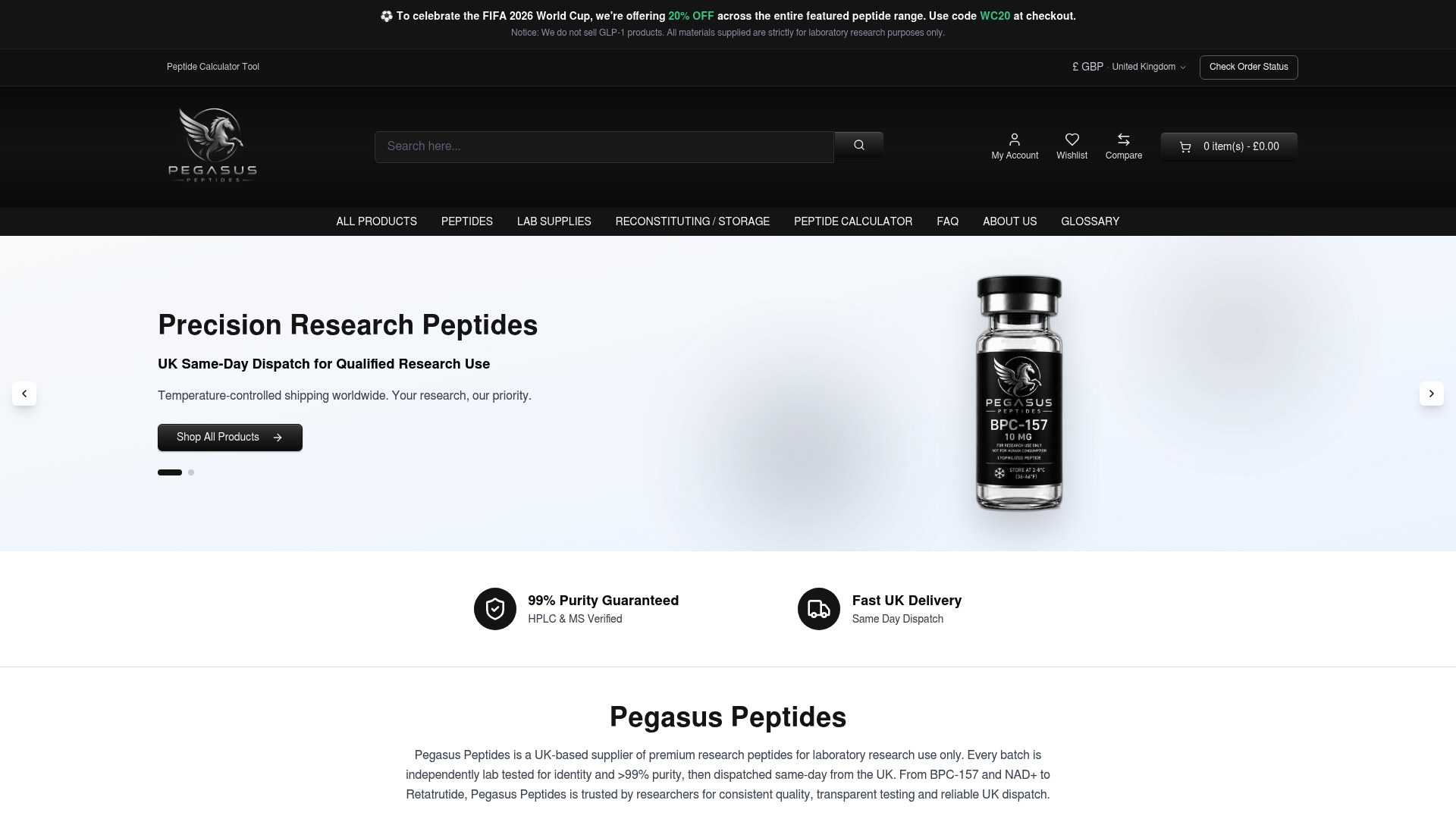
Every order from Pegasus-peptides is independently HPLC- and MS-verified for over 99% purity, dispatched the same day from the UK, and shipped worldwide with temperature-controlled packaging designed to maintain peptide stability in transit. For labs that cannot afford to receive degraded material, that combination of verified quality and controlled delivery removes a genuine variable from the research process. The peptide reconstitution and storage guide covers handling from arrival through to preparation, so the cold chain extends right through to the point of use.
Key takeaways
The most effective approach to temperature controlled shipping in the UK combines the right certifications, real-time monitoring, and contingency planning matched precisely to the cargo's temperature profile and regulatory requirements.
| Point | Details |
|---|---|
| Match service to temperature band | Controlled room temperature (15°C–25°C), refrigerated (2°C–8°C), and frozen each require different vehicles, packaging, and monitoring protocols. |
| Certifications signal compliance | ADR, Cold Chain Federation membership, and EU GDP certification are the key credentials to verify before appointing a UK provider. |
| Monitoring requires active response | Real-time IoT tracking only protects cargo when paired with buffer coolant capacity and contingency re-icing plans at transit hubs. |
| Cost reflects complexity | Temperature controlled freight costs more than standard shipment due to specialised vehicles, energy use, and monitoring technology. |
| Pegasus-peptides for research use | Pegasus-peptides offers same-day UK dispatch and worldwide temperature controlled shipping for HPLC/MS-verified research peptides at over 99% purity. |