
Independent third-party peptide testing is the only reliable way to confirm what is actually inside a research vial. It verifies purity, molecular identity, and safety through accredited analytical methods that have no connection to the supplier. For UK researchers, four providers currently offer verified testing or supply independently tested peptides: Peptidesauthor, Peptides Arena, Prime Peptide Research, and PureLab Peptides. Key quality markers to look for include:
- ISO 9001 certified quality management systems and UKAS-verified testing protocols
- HPLC purity analysis and mass spectrometry identity confirmation
- Endotoxin screening for any peptide intended for injectable research use
- QR-verified Certificates of Analysis (COAs) with traceable batch IDs
- Digital audit trails that allow online validation of individual test results
Vendor-supplied COAs alone are not sufficient. A COA without a verifiable independent lab name, batch number, or chromatogram is a common red flag in the peptide supply chain.
Which UK providers offer third party peptide testing?
Four providers serve the UK research market with independently tested or third-party verified peptides. Testing methods, turnaround times, and certificate verification approaches differ meaningfully between them.

| Provider | Testing Methods | Purity Guarantee | Certificate Verification | UK Availability | Rating |
|---|---|---|---|---|---|
| Peptidesauthor | Third-party HPLC, quality assurance | Verified purity | QR-verified COA | London, UK | 4.8★ (4 reviews) |
| Peptides Arena | HPLC, temperature-controlled QC | 100% purity guarantee | Per-batch COA | UK-wide delivery | 5★ (1 review) |
| Prime Peptide Research | Research-grade QC | Research-grade purity | Verified local COA | London, W1G | 5★ (1 review) |
| PureLab Peptides | Manufacturer QC, stringent quality checks | High-purity research grade | Manufacturer COA | London, Harley St | 5★ (1 review) |
Peptidesauthor operates from London E1 and positions itself as a wholesale source for UK researchers. Its third-party quality assurance and verified COA process make it a practical choice for researchers who need established supply with documented purity credentials.
Peptides Arena stands out for its catalogue breadth, covering peptides including BPC-157, Cerebrolysin, and CJC-1295/Ipamorelin, with product prices ranging from £20 to £1,320. It provides a purity guarantee supported by per-batch COAs and temperature-controlled UK delivery, which matters for peptides sensitive to thermal degradation during transit.
Prime Peptide Research operates from Harley Street, London W1G, offering a locally grounded service with personalised support. For researchers who prefer direct contact with a UK-based team rather than a purely online transaction, this is a practical option.
PureLab Peptides, also based on Harley Street, focuses on manufacturer transparency and stringent quality checks. Its London location and research-grade positioning suit UK laboratories that prioritise direct manufacturer accountability.
How do you submit peptides for independent testing in the UK?
The process for obtaining third-party lab analysis is straightforward, though preparation matters. Independent testing typically costs €40–150 depending on the tests requested, requires 1–5 mg of sample, and returns results within 5–14 business days.
- Select a lab. Choose an ISO 17025 accredited laboratory. For UK and European researchers, labs such as Janoshik (Czech Republic) and Liquilabs (Czech Republic) are established options listed on independent directories. Confirm the lab can test your specific peptide before shipping.
- Choose your test type. HPLC purity analysis is the minimum for any verification. Add mass spectrometry for a first-time vendor or high-value peptide. Include endotoxin screening for any injectable peptide.
- Prepare and ship your sample. Most labs require 1–5 mg. Ship without revealing the supplier name to remove any potential bias from the analysis.
- Receive and verify the COA. Cross-check the batch ID against your vial label. Confirm the lab name and accreditation status appear on the document. A COA with no identifiable lab or missing batch number should not be trusted.
- Compare against benchmarks. Check your results against the vendor's own COA claims and any existing independent data for that peptide and supplier.
Pro Tip: Before commissioning your own test, search independent databases for existing results on your vendor and peptide. If verified data already exists, you may be able to confirm quality without incurring additional testing costs.
Red flags to watch for in any COA: round purity numbers with no chromatogram, identical COAs across multiple products, no named testing laboratory, and batch numbers that do not match the vial label.
What testing methods do accredited peptide labs use?
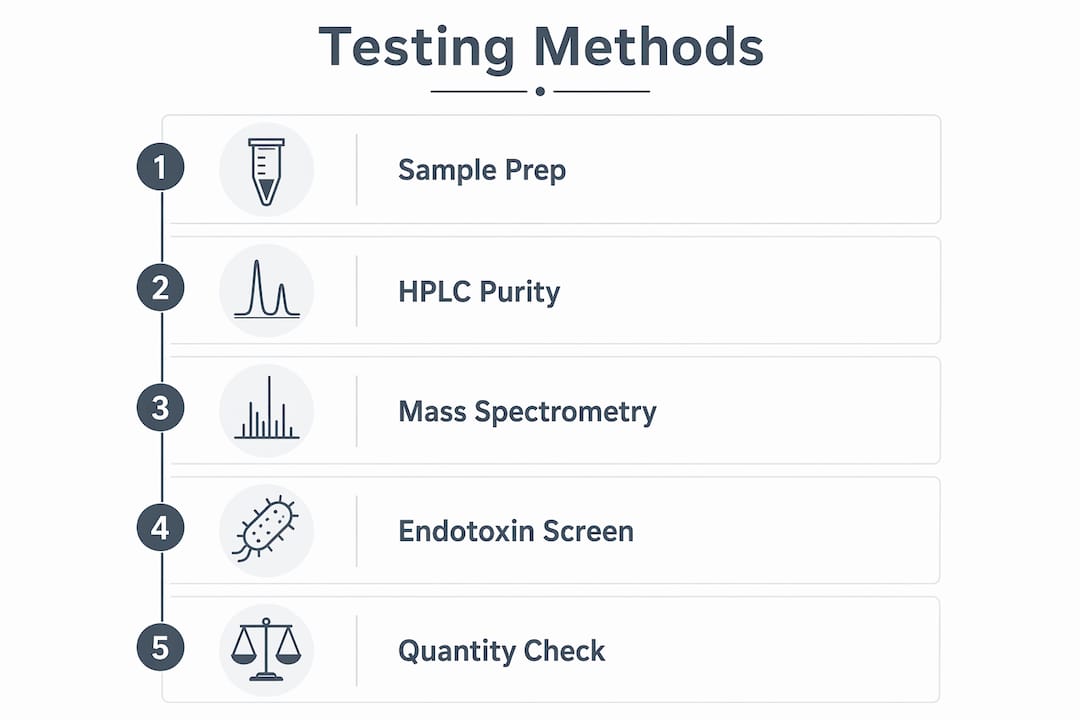
Four analytical methods underpin credible peptide quality testing. Understanding what each confirms helps you select the right test package and interpret results accurately.
HPLC purity analysis measures the proportion of the target peptide relative to impurities in the sample. A result of ≥95% is acceptable, ≥98% strong, and ≥99% is considered premium grade. Critically, peptide impurities at just 1% of total weight can produce measurable biological effects, which means even small purity differences carry real consequences for research reproducibility.
- HPLC is the baseline test for any verification and should always be requested
- A discrepancy of under 5 percentage points between two labs is within normal analytical variation
- A discrepancy exceeding 5 percentage points indicates a genuine quality problem
Mass spectrometry (MS) confirms molecular identity by measuring the observed molecular weight against the theoretical value. A result within ±1 Dalton confirms identity; a deviation exceeding 100 Daltons signals an incorrect compound entirely. MS is particularly important for first-time vendors and high-value peptides such as semaglutide or tirzepatide.
Endotoxin screening (LAL testing) detects bacterial endotoxins in the sample. The FDA threshold for parenteral products is 5 EU/kg body weight. This test is non-negotiable for any peptide used in injectable research.
Quantity verification confirms that the actual milligram content matches the labelled amount. A deviation greater than 10% of the labelled quantity is considered a quality failure. This test is often included with HPLC at no additional cost.
Together, these four methods provide a complete picture of purity, identity, safety, and dosing accuracy. No single test covers all four dimensions.
Why does transparency in UK peptide supply matter?
Vendor-supplied COAs frequently diverge from independent results. The gap between claimed and verified purity is a known issue across the research peptide market, and it is precisely why independent peptide analysis exists as a discipline in its own right.
Digital QR verification and ISO/UKAS accreditation are the two most meaningful trust signals a UK supplier can offer. A QR code on a COA that links to a permanent, unalterable lab record makes forgery practically impossible. ISO 17025 accreditation, the international standard for testing laboratory competence, means the lab's methods have been independently validated. These are not marketing claims; they are auditable credentials.
Community-submitted test data enhances transparency across the research community by identifying inconsistent batches and unreliable vendors before other researchers encounter the same problems. Platforms that publish independent results regardless of outcome, including poor purity findings, provide a more reliable picture than any single supplier's documentation.
UK suppliers with strong purity guarantees and documented quality control procedures, including Peptides Arena's per-batch COA system and Peptidesauthor's third-party verification process, represent the standard researchers should expect as a baseline.
Pro Tip: After receiving your independent COA, submit the results to a public testing registry. Published discrepancies protect other researchers and strengthen collective accountability across the UK peptide supply chain.
Key takeaways
Third-party peptide testing, using HPLC, mass spectrometry, and endotoxin screening from ISO 17025 accredited labs, is the only method that reliably confirms purity, identity, and safety beyond a vendor's own claims.
| Point | Details |
|---|---|
| Minimum test standard | HPLC purity analysis is the baseline; add MS for identity and endotoxin screening for injectable peptides. |
| Purity benchmarks | ≥95% HPLC is acceptable, ≥98% is strong, and ≥99% is considered premium grade. A discrepancy exceeding 5 percentage points between labs signals a real quality problem. |
| COA verification | Cross-check batch IDs, confirm the lab name and ISO 17025 accreditation, and reject any COA with no chromatogram or unnamed lab. |
| Sample and cost | Independent testing requires 1–5 mg of sample and costs €40–150 depending on the test panel selected. |
| Pegasus-peptides | Pegasus-peptides supplies independently lab-tested research peptides verified at over 99% purity, with same-day UK dispatch. |
The standard UK researchers should hold suppliers to
The most common mistake researchers make is treating a vendor COA as equivalent to independent verification. It is not. A COA produced by the vendor's own in-house lab, or by a lab with no verifiable accreditation, tells you what the supplier wants you to know. An independent COA from an ISO 17025 accredited third party tells you what is actually in the vial.
The UK research community has made real progress on digital verification. QR-linked certificates that resolve to permanent, publicly accessible records are now technically straightforward to implement. Suppliers who have not adopted this standard by 2026 are making a choice, not facing a constraint. Researchers are entirely justified in treating the absence of digital traceability as a reason to look elsewhere.
ISO/UKAS accreditation matters because it is not self-declared. It requires external audit, documented method validation, and ongoing compliance. When a lab carries UKAS recognition, the credibility of its COAs rests on an independent assessment, not on the lab's own assurances. That distinction is what separates credible peptide quality testing from paperwork.
The obligation runs both ways. Suppliers must provide verifiable documentation. Researchers must demand it, verify it, and contribute their own independent results to community databases. Collective data sharing is what makes the whole system work.
Pegasus-peptides: independently tested research peptides, ready to dispatch
If you are sourcing research peptides rather than commissioning standalone testing services, Pegasus-peptides offers a direct alternative worth considering. Every product in the Pegasus-peptides catalogue is independently lab tested to over 99% purity before dispatch, with same-day UK shipping and worldwide temperature-controlled delivery.
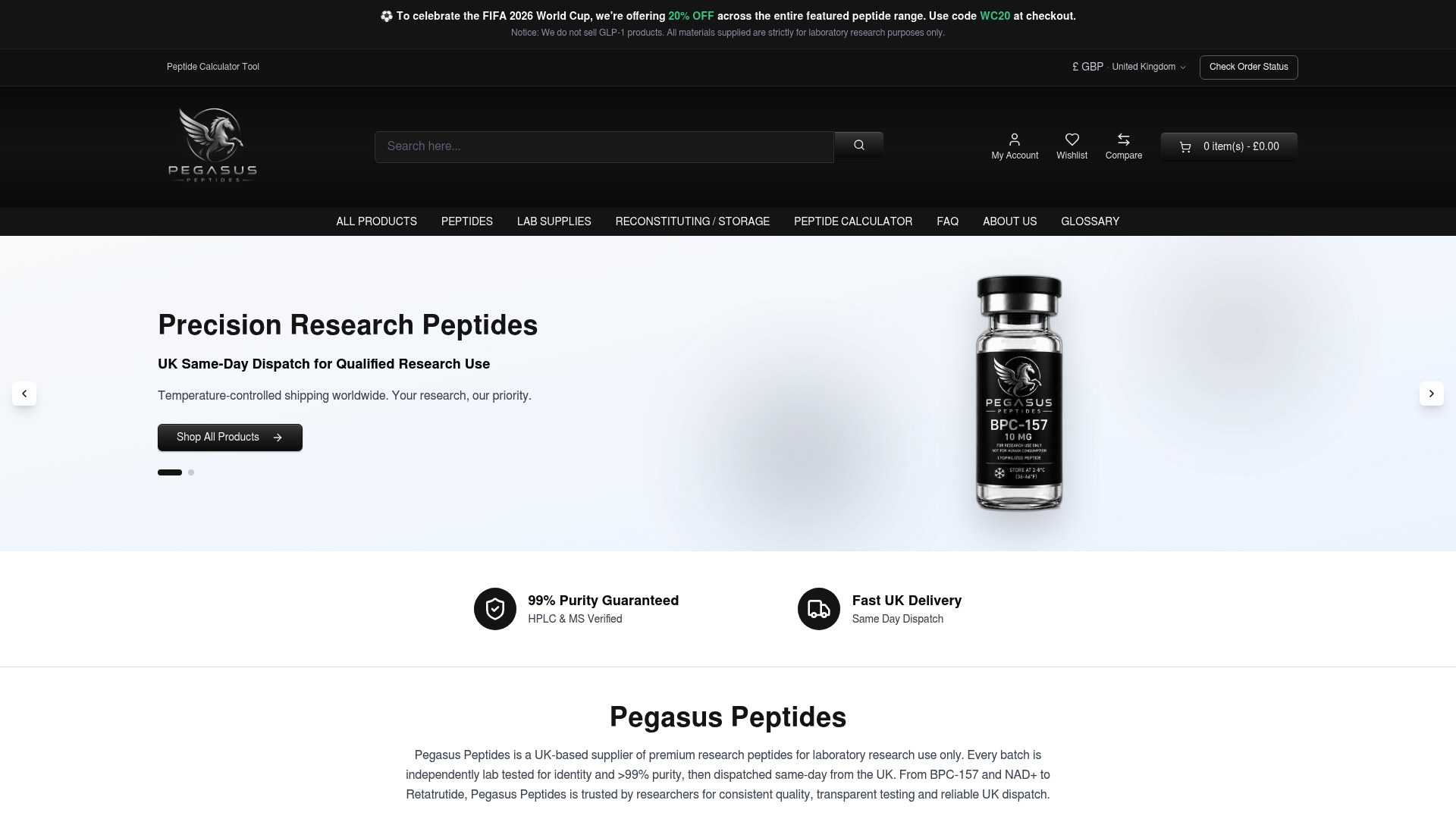
The difference from the providers compared above is straightforward. Pegasus-peptides is a UK-based peptide supplier, not a standalone testing laboratory. You receive research-grade peptides with third-party purity verification already completed, rather than sourcing raw material and arranging independent analysis separately. For researchers who need verified peptides quickly, the research peptides catalogue covers a broad range of compounds with documented purity credentials and no minimum order requirement.